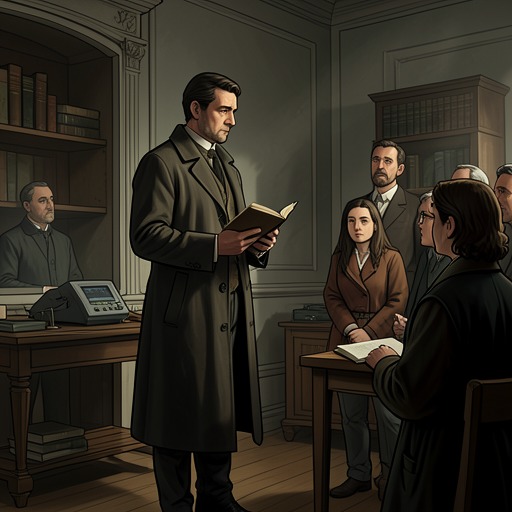
Fitzedward Hall
The Surgeon of CrowthorneFitzedward Hall’s life joined scholarly distinction to a long retreat from public life, while his daily work for James Murray helped give the Oxford English Dictionary a documentary history of words, senses, and idioms. Invited to the Oxford dinner celebrating the Dictionary, Hall did not attend; his absence was explained by his reputation as a recluse, but his sustained collaboration with Murray made him one of the project’s indispensable allies.
Early Life and Scholarly Career
Hall came from Troy, New York. In 1848, just as he was about to enter Harvard, his family sent him to Calcutta to search for an errant brother. The voyage ended in shipwreck in the Bay of Bengal. Hall survived, became fascinated by Sanskrit, and pursued its study with such dedication that he was eventually offered the Chair in Sanskrit at Government College in Benares, described in the account as the holiest city in the Ganges valley.
During the 1857 Mutiny, Hall served as a rifleman on the British side. He left India in 1860 and continued his academic career in London, becoming professor of Sanskrit at King’s College and librarian at the India Office. The account groups him with another American volunteer who had spent time in India and served as a soldier, describing both men as mad. It offers no specific diagnosis for Hall; instead, it traces the rupture in his life through conflict, accusation, and withdrawal.
Dispute and Retreat
Hall’s career fell apart after a grave quarrel with the Sanskrit scholar Theodor Goldstücker. The precise reason for the dispute remained uncertain, but its consequences were stark: Hall quit the India Office, was summarily suspended from the Philological Society, and left London for the small Suffolk village of Marlesford.
People there called him a drunkard, a foreign spy, immoral, and an academic fraud. Hall, in turn, believed that Britons had united against him, ruined his life, driven away his wife, and shown hatred toward Americans. He locked himself inside his cottage and lived as a near-total recluse, making only occasional steamer voyages back to New York. The contrast between his earlier institutional standing and his isolation is central to the account: the scholar withdrew from academic society, but not from scholarly work.
A Sustained Partnership with Murray
Hall wrote to Murray at Oxford every day, and their correspondence continued for twenty years, although the two men never met. He compiled quotation slips, answered queries, and offered advice without complaint, remaining a staunch ally of the Dictionary through its bleakest period. His contribution was not a single celebrated discovery but a durable practice of supplying evidence and assistance over time.
Murray’s preface recorded Hall’s collaboration as invaluable to the literary and documentary history of countless words, senses, and idioms, and noted that Hall’s contributions appeared throughout the Dictionary. Murray later placed Hall’s work ahead of even the substantial weekly quotations supplied by William Chester Minor in enriching the record of individual words, phrases, and constructions. The recognition captures the scale of Hall’s service: the Dictionary’s account of language rested in part on the steady labor of a scholar who had withdrawn from nearly every other public connection.
Death and Continuing Influence
Hall died in 1901. His death prompted William Chester Minor, then at Broadmoor and increasingly isolated, to send Murray a letter of deep sadness. Minor’s condolences were accompanied by a request for more quotation slips for the letters K and O; news of Hall’s death briefly revived his interest in the work. The episode shows Hall’s influence extending beyond his own correspondence with Murray: even in his final years, the loss of this fellow American scholar could draw Minor back toward the Dictionary.
Hall’s story therefore holds together two apparently opposed forms of retreat and participation. He became a country recluse after his professional and personal rupture, yet remained in active intellectual contact with Oxford through letters and lexical evidence. His absence from the dinner was not an absence from the Dictionary’s history; the pages themselves carried the record of his work.